
2003 - The Abandoned Garden
2003 was a year of recovery after two years bordering on insanity. Beginning 2000, I had been working on a digital video software based on Microsoft's "Direct Show". We really pushed the envelope with this software, doing things which nobody else had in their video watching programs, and I kept hitting rock walls in Microsoft's building blocks which I had to first understand, then work around, etc.
I finished that stuff in late 2002 with an agonizing series of business trips, right at the same time where my teeth got renovated and I would have preferred to spend my days in bed with the head under a pillow...
After that, everything got better. After nearly three years of slave work, I finally could enjoy a few hours outside the office. It was a disappointment to find that much of my cherished garden had returned to wilderness, but as we will see later, this had its good sides too.
Although notoriously "too little, too late" with my garden work, I managed to have some seedlings ready for planting right at the time where Paul had prepared a few fields. This year, no hospital stay and no surprise epidemic hit us. Also the weather had a little more mercy than in the last few years where it was bordering on a drought a few times and we lost several of our newly planted treasures.
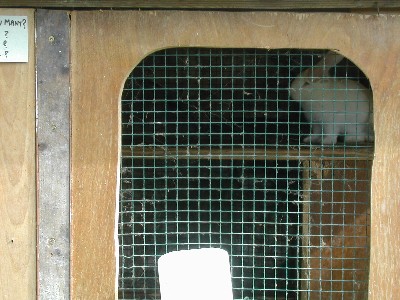
Moreover, instead of disposing of them "quietly and without sorrow", Paul spread wheelbarrows full of miracle pills in the freshly ploughed fields, which get produced by little helpers who thrive in our garden, or better in "circus cages" built by Paul - big semi-natural living spaces with caves and various steps and boards for their plays. They eat weeds and make fertilizer - what a deal!!

Today, after my return from another very challenging business trip, I went through the garden with the digital camera and had a look at three years of interaction between our mountain's ecology, a hobby gardener in training who just begins to develop the feelings a gardener needs (Paul), and another gardener (myself) whose absence is glaring at you from every corner of that poor abandoned piece of Austrian soil.
But hey, what a joy to steal myself away from the office!
I should add one more thing. We have a pioneer in Austria, Sepp Holzer, well hated by the authorities but loved by the university's biology professors. He invented, or better re-invented an intriguing gardening style long before it got the colorful name "permaculture", with the result that he is growing mediterranean plants in the Austrian mountains and has to deal with the garbage of busloads of biology students who invade his place in such numbers that he just recently had to find a new priestine piece of soil to play with.
Holzer's ideas have been spooking around in my head for a long time. It is quite a project to cultivate plants which are used to having their natural competition removed (a process called "weeding") in a semi-natural cycle without losing them within a year or two. A difficult balance must be kept between interference and no-interference, some of the traditional knowledge of gardeners has to be thrown out but other parts of it need to be remembered, and of course an absence of three years with only sporadic visits makes it even more complicated.
The nice thing is that walking through a piece of property which went out of control, is an adventure. And I invite you to join me in that adventure. I found some quite amazing things today!
The first impression is that all is thriving. To the left we
look across the first field I planted this year, to the right we see a row of
tomato plants which are doing just great.

It's still a little early in the year, but the inquiring mind can find fruits if he puts his camera close enough. We are testing several varieties, here we see big meat tomatoes and little cocktail tomatoes, but there are also salad tomatoes in the collection and "Roma", the traditional Italian variety which they use for their pasta.


But the real hit this year are the cucumber plants. Everything from that family is having a ball with the warm weather and frequent but short rain periods. The last few years all were a disappointment, but this year we have picture book plants. Just a week ago I harvested the first three zucchini, and yesterday I went out and came back with a whole box full, weighing at least 10 kilo, if not 15! Some of the plants are really enormous.
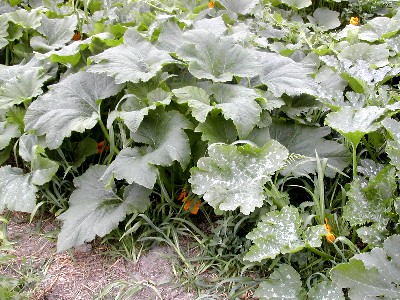

One of the biggest is shown above, it's a white UFO squash,
but we are also testing all kinds of pumpkins, and of course there are the
zucchini plants for the kitchen.
My favourite is the Halloween pumpkin, which has only leaves so far, no fruits. Patrick (10) and Rüdiger (14) each got a little pot with a seedling for Patrick's birthday on the 4th of May, and now these things already have two meter long vines which dominate even the walkway, and leaves which are big and beautiful enough to be displayed in a garden museum!
Something we don't see all of, is the great "biodiversity" in this organic garden. Millions of little grasshoppers (not the dangerous bigger variety) escape to all sides under our footsteps and millions of earthworms work the soil, occasionally being eaten by one of the few genuine moles we have (most of the underground diggers are, unfortunately, root-eating voles - they wiped out every single tulip I had).
Millions of nasty big brown slugs are already gone from
this habitat, because - having no natural enemy in our ecology - Paul is out
there several times a week and comes back with two or three kilo of them every
time. Without that heroic battle, fought with surgical gloves to avoid their
ugly slime, there would be no single zucchini or cucumber plant growing, as they
prefer them over every other food (except young dahlia plants), and devour them
all overnight in the 3-leaf-stage in which they get planted.
28 years after Rachel Carson's famous book "Silent Spring", I
walk through my stamp-sized tiny piece of property and am surrounded by
butterflies! This one flew out of the zucchini field as I tried to come closer,
but I already had it in the camera from a greater distance...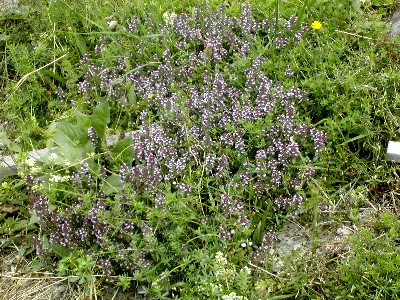
In three years of very little interference, a lot of wild
plants have shown up. To the left there is a patch of wild thyme in full bloom.
Paul said "I simply couldn't move the scythe through it" - having worked in the
garden only as a boy, he now develops a real gardener's heart! (If he's not just
doing something like hammering a nail into a tree to store his hose pieces - see
below...)

This year's sensation is the plant below. It appeared in the middle of 2001's potato field, which last year was taken over by "wild" topinambur (escaped from their original field).
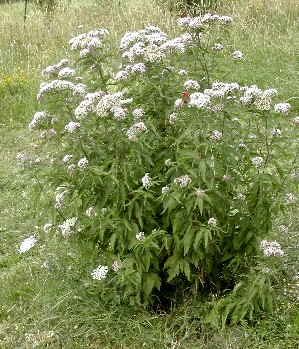 We watched the unknown plant through the whole spring. Not
knowing what it was, Paul mowed around it. When he watered his berry cuttings,
he also gave a squish of water to the unknown guest. It became so beautiful and
dominant that we couldn't have destroyed it even if we had wanted to. Just
recently, its flower buds opened and now I could find it in the book of European
plants and animals I have at my bedside.
We watched the unknown plant through the whole spring. Not
knowing what it was, Paul mowed around it. When he watered his berry cuttings,
he also gave a squish of water to the unknown guest. It became so beautiful and
dominant that we couldn't have destroyed it even if we had wanted to. Just
recently, its flower buds opened and now I could find it in the book of European
plants and animals I have at my bedside.

The picture to the right shows its flowers in all stages - buds, open flowers, and wilting flowers going into seeds. Apparently it is a valerian plant - while I am still planning a future herb garden, this precious one, which I tried to grow from seeds several times without succeeding, came to me entirely on its own! It is attracting every kind of insect: bees, bumblebees and several varieties of butterfly - a buzzing center of life in my garden. Then, just a week ago on a bicycle trip, I found out that it is growing everywhere in the area, even on steep rock walls. Things you don't see from a car window!
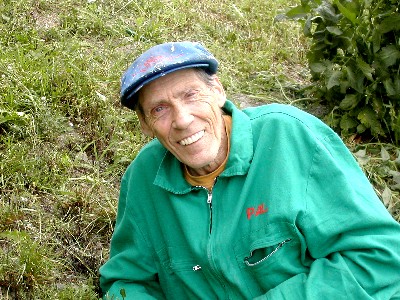
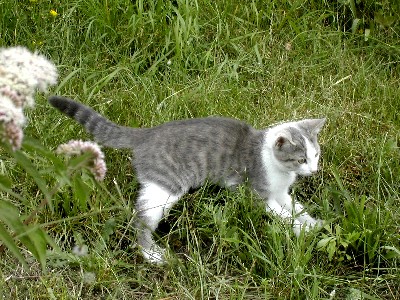
There are also some alien life forms around the valerian plant - one Paul, who immigrated from Canada (of course he must wear the overall where I stopped stitching "Paul" in the middle of the "U" - instead of wearing one of the two where I finished the job) - and one cat "Spooky", whom I imported about a month ago from Upper Austria in order to bring fresh cat-blood to our mountain, on which too many cats have died in the last year, most probably from feline leukemia. Spooky got vaccinated against it, so there should be an end to the cat deaths - if not one day she loses a staring fight with a car driver (so far, the cars always respected that she considers the road her territory and will not move away - they have to steer around her!)
 There
are more wonders to be found in this garden. Our neighbour has a hazelnut hedge
which separates him from our chickens. I never saw a single nut on any of his
plants (maybe they are all male plants, hazelnuts come in two genders), but here
on our slope there is a female hazelnut, probably planted by a squirrel, and although it has only one third of
the height of his hedge, this year it already has the first handful of nuts!
There
are more wonders to be found in this garden. Our neighbour has a hazelnut hedge
which separates him from our chickens. I never saw a single nut on any of his
plants (maybe they are all male plants, hazelnuts come in two genders), but here
on our slope there is a female hazelnut, probably planted by a squirrel, and although it has only one third of
the height of his hedge, this year it already has the first handful of nuts!
We are coming into the orchard. It was a piece of plain
meadow when I came to this place (the whole garden was a meadow). Now it has 23 trees. 8 of them I planted in
the spring where I first met Paul. 16 were planted by Paul in the fall of the
same year 1998, where he still had cancer and I tried to have him work outside
as much as possible to get his body flooded with oxygen. Two trees got lost, one got replaced - so 23 are left.
To the left there is a miniature sour cherry tree - we have sweet cherries on big trees.
 To
the right there are some cucumbers which I am trying to lead up the fence, which
also got "planted" by Paul in 1998. We normally work in wood, but these 30
meters of fence are wire, which I use as support for peas, beans and cucumbers.
To
the right there are some cucumbers which I am trying to lead up the fence, which
also got "planted" by Paul in 1998. We normally work in wood, but these 30
meters of fence are wire, which I use as support for peas, beans and cucumbers.
The soil between the trees was supposed to be covered by strawberry plants. I actually had about 3 quarters of the "orchard" populated by strawberries, but that project would have requried two or three more years of weeding, which I couldn't afford. The strawberries are still there (last year we filled quite some freezer space with fruits), but overgrown by competition like grass, herbs, weeds... and in one spot they got especially strong competition: a double row of horseraddish plants, which I imported from a supermarket.
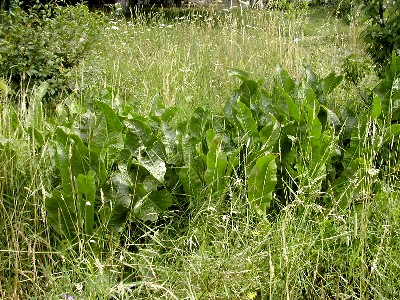 They grow wild in our country, but I didn't have any on my
property. So I just bought a kilo of roots, meant to go into beef stew or fresh
cheese, broke them in half, planted the pieces and ended up with an explosion of
the most powerful plants you can imagine!
They grow wild in our country, but I didn't have any on my
property. So I just bought a kilo of roots, meant to go into beef stew or fresh
cheese, broke them in half, planted the pieces and ended up with an explosion of
the most powerful plants you can imagine!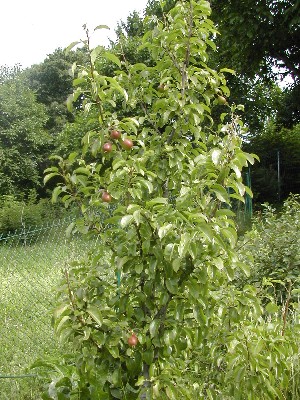 I tried to transplant them to a different location later, away from the
strawberries, but the bits and pieces which I left in the
ground were sufficient to restore the whole horseraddish population.
I tried to transplant them to a different location later, away from the
strawberries, but the bits and pieces which I left in the
ground were sufficient to restore the whole horseraddish population.
To the left there is a pear tree with first fruits. Most trees I bought are in the "bush" format (the second smallest of four formats), which is supposed to bear fruit in the 3rd year after planting. But I think with one or two trees I made a mistake in the garden shop and got "half trunks", the second highest format. They will be big enough for my grandchildren (who are not born yet) to climb up on them!
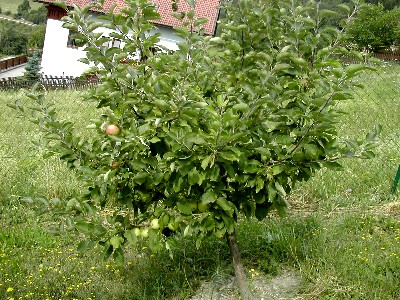 To the right there is an apple tree in beautiful shape.
For the first time, it is really full of apples (most are hidden
by leaves though).
To the right there is an apple tree in beautiful shape.
For the first time, it is really full of apples (most are hidden
by leaves though).
My garden used to be a paradise for the vole, an underground
digger whose mazes can become so prominent that people's feet suddenly disappear
20 centimeters into the ground as they walk through a meadow. Garden books recommend to plant
the imperial crown, a majestic spring flower, whose smell the voles don't like.
But it seems that I have a special species of voles, because they ate all but
one of the imperial crowns I had planted around my fruit trees!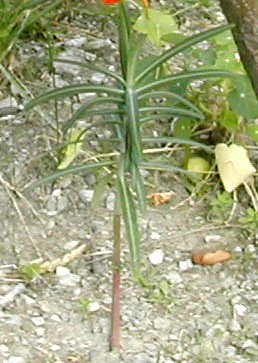
So I remembered the hint of my long-dead grandfather who, when I was the age of my daughters now, told me about a plant which the voles abhor, a member of the "Euphorbia" family. Of course, the garden shops know it too and will sell you the seeds (although they prefer to sell you the more expensive bloody vole traps, various poisons and every kind of gas administering equipment).
I grew "Euphorbia Lathyris" from seeds in several gardens. They become wild after a year or two. Here it took me two years until I really
got to planting them when the seedlings were ready. I hope they will take care
of their own propagation from now on. To the left there is one such seedling
right after planting.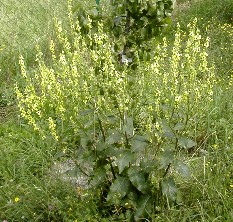
I also allow some native plants to share the space with the strawberries (I will come back to them!) and fruit trees. Here is one example, a mullein plant. The whole "Verbascum" family is living on our mountain. In our garden, only the medium size variety has taken root. But we have the majestic "King's Candle" (literal translation from its german name), which is higher than a man, on the mountain too. One day I will harvest some seeds and then the plant will grow on our property!
 The
little tree to the left is touching my heart each time I come its way. It is the
first of the 8 trees I planted in spring 1998, while I was dreaming of Paul to
move over from Canada.
The
little tree to the left is touching my heart each time I come its way. It is the
first of the 8 trees I planted in spring 1998, while I was dreaming of Paul to
move over from Canada.
In summer 1998, Paul was already here and we had one of the worst hailstorms ever. On the 3rd of July, the whole mountain was covered with 30 centimeters of hail! I was on a business trip and didn't see it myself, but the people in the house told me the horror story.
Of course, that wiped out the whole planting season. Of the young brokkoli plants, only the stems were left (nevertheless, we harvested brokkoli from them that very same fall!) The hail threw all the ripe cherries down from the trees - when I returned, I was wading through cherry marmelade, and didn't need to think about buying bottles for cherry preserves anymore.
All my young trees had suffered, but this one had especially
deep wounds and looked more dead than alive. Since then, I am pampering it and
try to help it with intelligent cutting. It showed some fruits every spring, but
never could support them to harvesting size. This year, five years after the
disaster, it will have the first few full sized fruits! The wounds have healed
so well that they cannot be seen anymore, and with a delay of some years this
will be a healthy apple tree.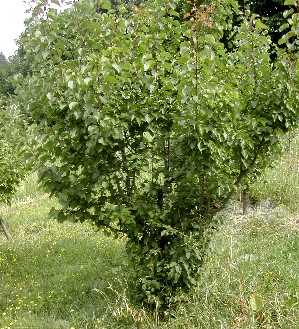
The apricot trees also have their special story. Although they are still young - meaning that they still have to build a crown and their strength goes into the wood more than into fruits -, they are covered with flowers every spring. Some years, they even had tiny little apricots, but so far, the spring frosts always destroyed them.
They are still the healthiest and prettiest trees I have. I have placed my bet on the arrival of global warming on this mountain. Apricots typically don't have fruits above 700 meters. We are close to 900 and sooner or later there will be apricots on these trees...!
The area close to the big old walnut tree is not especially healthy for fruit trees. I lost one apricot tree (which I replaced - the new one is doing fine), and one apple tree.
 Experts
say that the walnut tree poisons the soil for other plants. But actually the
apple trees up there are not so close to the walnut. The tree to the left is
really in poor shape, and it wasnt't in any better shape when it was still
surrounded by neat and pretty strawberry beds (which have now disappeared under
high grass).
Experts
say that the walnut tree poisons the soil for other plants. But actually the
apple trees up there are not so close to the walnut. The tree to the left is
really in poor shape, and it wasnt't in any better shape when it was still
surrounded by neat and pretty strawberry beds (which have now disappeared under
high grass).
Two of the three trees were sitting loose in the soil one day. I couldn't believe it. Was it the wind which had shaken them too much and too early? But isn't wind an essential factor for building a strong root system - so much that they use artificial "wind machines" (which shake a young tree in certain intervals) in greenhouses where there is no wind? Must have been the voles again. I certainly hope it's not the bad bacterial infection which cost Austria's fruit farmers already thousands of apple and pear trees.
I planted one "vole plant" close to each of the trees which
are still there (we lost one last year), gave them some extra water, and when I
inspected them today, one of the branches seemed to look better than before and
have new and stronger green leaves. But it is still a miracle. This tree has
been planted in 1998 like the others, and look at the difference!
The picture to the right shows my whole "orchard", with the neighbour's gingerbread house as a background. Yes, it is a baby orchard, but we do love it! In a few hours it will be raining, I barely had enough light for the fotos.
The tiny piece of rock garden below resulted from digging through the whole garden for the sewer canal. We found enough big pieces of rock to build little rock walls along the slanted wheelbarrow trails. I want to decorate more of them - there are so many plants which I dream of having around -, but so far this was the only piece which I found time for.
 Some of the rock plants to the left appeared there on their
own...! There must have been a rock garden on this property before, which got
overgrown before we moved in. Some plants escaped and can now be found in all
the steep and sunny spots of the garden.
Some of the rock plants to the left appeared there on their
own...! There must have been a rock garden on this property before, which got
overgrown before we moved in. Some plants escaped and can now be found in all
the steep and sunny spots of the garden.
This (see picture below) is what happens if you don't eat up your winter storage of topinambur! We "imported" a bag of topinambur a few years ago from the agricultural supply shop. They had to order them and we waited a while, but finally we had enough topinambur to plant a whole field.
 It did great in the first year, but then suffered from hot
and dry weather, from not being thinned out and not being fed well (at that
time, our rabbit production was only at the beginning). I was just about to
become sad about the failure, but then enormous "wild" topinambur plants began
to show up on the whole property! Last fall Paul harvested them all and stored
them outside under an earth mound... which became a topinambur bush this spring
(we had eaten only three quarters of the crop).
We'll take the young bulbs out in fall and plant them again in a fresh, well
fertilized piece of ground. They will be too small for eating anyway, because of
their crowded conditions.
It did great in the first year, but then suffered from hot
and dry weather, from not being thinned out and not being fed well (at that
time, our rabbit production was only at the beginning). I was just about to
become sad about the failure, but then enormous "wild" topinambur plants began
to show up on the whole property! Last fall Paul harvested them all and stored
them outside under an earth mound... which became a topinambur bush this spring
(we had eaten only three quarters of the crop).
We'll take the young bulbs out in fall and plant them again in a fresh, well
fertilized piece of ground. They will be too small for eating anyway, because of
their crowded conditions.
This is our little pond. It consists of an old bathtub, and
unfortunately the man who built it (not Paul) somehow managed to make it leaky,
so that one day we will have to dig it out and replace it with a professional
biotop form (which will also give me some space for the swamp plants which I now
cannot plant because right above the water the soil is totally dry).
The two water lilies which I planted between a few rocks have
overtaken the space so much that bees and birds nearly don't find water anymore!
Also, the flowers are hidden away under the leaves - only in late spring I have
the chance to see a few water lily flowers...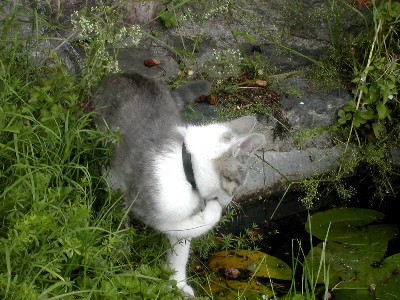
We even have our own water quality tester!
One funny thing about that pond is this: it is breeding mosquitoes like mad. But we hardly ever get stung by a mosquito! The only bad mosquito season was 1997, when I had no pond but only a few forgotten planting bowls with rain water in them. The solution to this miracle was found by Paul one day when he sat in the garden quietly after the sun had set. There were black "birds" in the garden, flapping around totally noiselessly - but what birds are out there when it is dark? They were not big enough to be owls... and of course they were no birds either.
We have bats on the mountain, and they just love our constant supply of mosquitoes! We don't know where they live, maybe in a nearby barn or attic (not in ours though), or maybe in a cave. They service the property better than any spray can ever could!
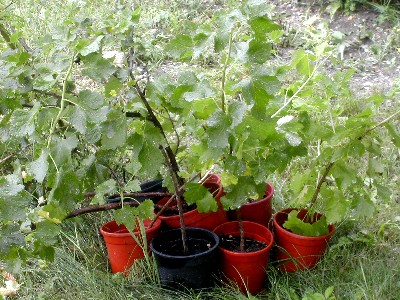
Here are Paul's first attempts at propagating plants. He had
torn out a berry bush from a storage corner where some plants lived which I
hadn't found the time to plant. But this one bush was so lively that I didn't
want to lose it. I asked Paul to plant it into a pot and - in order to help the
injured roots which now were no longer strong enough to feed the whole big
individual - to cut off some of the longer twigs and plant them into pots as
well. Here is the outcome: a whole little berry nursery in absolutely perfect
shape! This fall we will plant them as a replacement for the red and black
currant bushes we lost to last year's drought.
To the right: A Kiwi vine crawling along our house's wall. In a shop, I found hermaphrodite Kiwi plants (they normally come in two genders). I planted two - what happened to the second, I couldn't tell. I am curious when we will see the first fruits.
Below: A nectarine tree living as an espalier along the south
wall of our furnace room (former garage). Although our elevation is several 100
meters too high for the peach family, this tree gets warmth from the wall, and in
winter the frosty air flows down the slope instead of gathering around the tree. It is full of fruits every year. I
bet if I had planted the apricot trees in such a spot, they would yield fruits
too!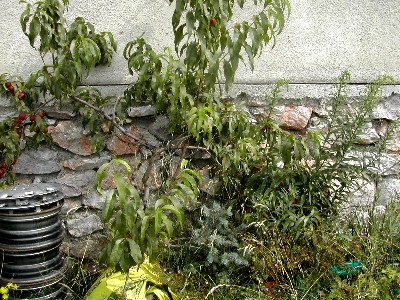
During the first years, the nectarine had troubles with various micro organisms which would crinkle its leaves and cause its fruits to foul just as they were ripe. This year, it looks just perfect. I didn't treat it or anything. Just every now and then, I had a talk with the tree and encouraged it to keep negotiating peaceful coexistence with the buggers.
There is a second nectarine growing right beside it (they are number 25 and 26 of the trees we planted in 1998). It got hit by a falling fir tree and will need another few years to recover. Also, one day my telepathy will be good enough to let Paul know that car wheels can live in the attic instead of decorating the garden...
 The
flowers to the right are not a decoration for our kid's old sandpit (we really
have to remove it this year) - they are seedlings which didn't get planted in
spring 2002, went through the winter 2002/2003 in the same place, and in spring 2003 they had
grown long roots through their pots and couldn't be carried away anymore! The
abandoned rudbeckia, as proud and pretty as any well-pampered garden plant! This
fall I will have to dig them out with the pickaxe and find them an especially
rewarding piece of soil.
The
flowers to the right are not a decoration for our kid's old sandpit (we really
have to remove it this year) - they are seedlings which didn't get planted in
spring 2002, went through the winter 2002/2003 in the same place, and in spring 2003 they had
grown long roots through their pots and couldn't be carried away anymore! The
abandoned rudbeckia, as proud and pretty as any well-pampered garden plant! This
fall I will have to dig them out with the pickaxe and find them an especially
rewarding piece of soil.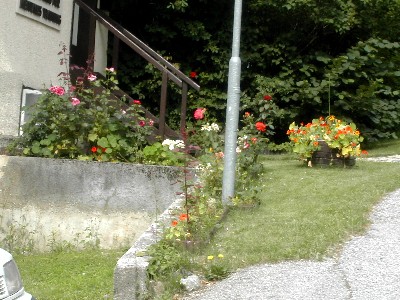
The workgroup entrance, nearly five years after Paul created a garden space from what the former tenants used as a junk yard. The next planned upgrade is flower boxes under the windows, but I am already happy with it now, with all the roses and the little piece of "real lawn" (all the other parts of the property are what is called a meadow, mowed only twice a year and used for rabbit food, if we don't turn it into vegetable fields).
 To
the right there is part of the nursery where my plants live before they go out
into the garden. It is situated north of the house, which allows me to first
move the seedlings into the shadow and then gradually into full sunlight. Coming
out of artificial light, they are not used to the strong UV light we have up
here on the mountain. I burned several generations of seedlings before I learned
to treat them right.
To
the right there is part of the nursery where my plants live before they go out
into the garden. It is situated north of the house, which allows me to first
move the seedlings into the shadow and then gradually into full sunlight. Coming
out of artificial light, they are not used to the strong UV light we have up
here on the mountain. I burned several generations of seedlings before I learned
to treat them right.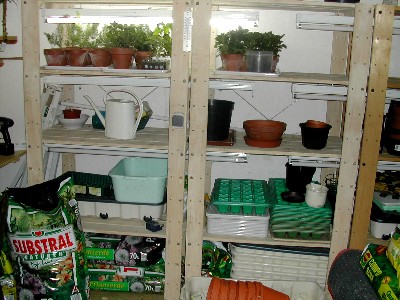
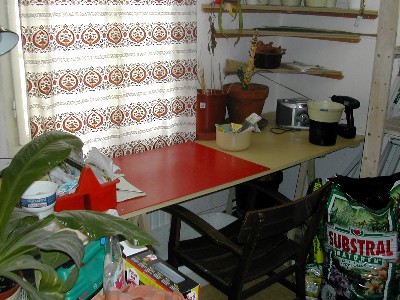
Here is the little horticulture where I start my seeds and later transplant them into the pots from where they go into the garden. Once a year, in early May, I have all 8 lights on at the same time. That's just before bell peppers, tomatoes, zucchini, pumpkins etc. go out into hotbeds. Lettuce, cabbage and the like are already planted at this time, and their second generations started outside under the plastic protection of the low hotbeds.
 There
are many more stories to be told about this garden, some of them still in the
future. One of them is the "mediterranean corner" which I just started this
spring. It has a few fig trees, sweet bay, oregano (which I found wild in our
garden), and other mediterranean plants, all
still in their baby stages. Of course it will only survive if the rumors of
global warming are really true - sooner or later we will know it!
There
are many more stories to be told about this garden, some of them still in the
future. One of them is the "mediterranean corner" which I just started this
spring. It has a few fig trees, sweet bay, oregano (which I found wild in our
garden), and other mediterranean plants, all
still in their baby stages. Of course it will only survive if the rumors of
global warming are really true - sooner or later we will know it!
 Another
story is that of a future herb garden which already has first corner posts here
and there. For instance the enormous lovage plant, here to the left - they are
difficult to grow, but once they took root, they just grow bigger and prettier
every year.
Another
story is that of a future herb garden which already has first corner posts here
and there. For instance the enormous lovage plant, here to the left - they are
difficult to grow, but once they took root, they just grow bigger and prettier
every year.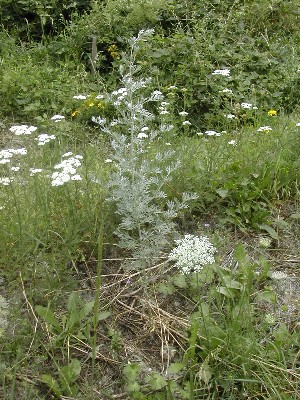
Or the line of 7 wormwood plants, one of them here to the right - I tried them several times and lost them year after year to my lack of time. But this time we made it, 7 perfect plants, secret weapons in the battle against the parasites which cause cancer! They are surrounded by wild yarrow in full bloom (the big white flowers) - a herb with a great reputation for the treatment of stomach problems.
 Or
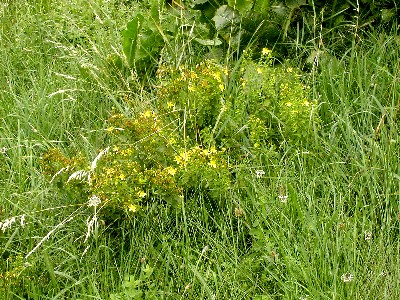
the nearly invincible St. John's wort, a herb famous for treating depression. If
you try to make a field out of a meadow, the St. John's wort is even more
stubborn than the couch-grass - and every gardener knows how stubborn that is!
Or
the nearly invincible St. John's wort, a herb famous for treating depression. If
you try to make a field out of a meadow, the St. John's wort is even more
stubborn than the couch-grass - and every gardener knows how stubborn that is!
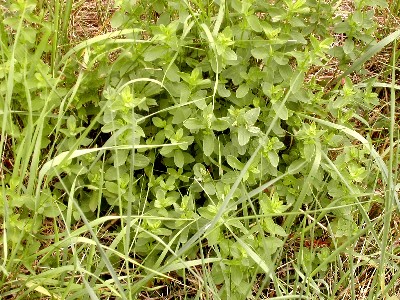 To
the right you see how it looks in the meadow before the flowers appear. If it
happens to exist in your area and you don't need to have a totally flawless
lawn, just let a few of them uncut (only freaks like ourselves mow around
absolutely everything they don't know or want to study for a year).
To
the right you see how it looks in the meadow before the flowers appear. If it
happens to exist in your area and you don't need to have a totally flawless
lawn, just let a few of them uncut (only freaks like ourselves mow around
absolutely everything they don't know or want to study for a year).
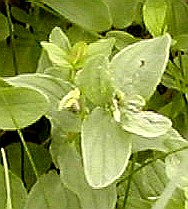
To the left you see the characteristic veined structure of its leaves. If you hold them against the light, they show tiny little "pinholes" which make its appearance even more typical. It is easy to use, just harvest it at flowering time, dry in a shady place, keep sealed against air, and put it into tea mixtures. Its flowers alone give a wound-healing oil.
Another amazing story is that of the foxtail (literal translation from the german name - its english name "love-lies-bleeding" is really a tongue-breaker!)
 I
tried to grow it for several seasons and always lost it early to strange
problems - fungus in the soil, too wet, too warm, or whatever else. Then last
year I had nice plants but again no time to plant them. At least one of them I
brought out, it went into the center of a flower box - which shortly afterwards
got devastated by a spring hail. Yet the plant survived - at least enough of it
to make a few sad looking emergency flowers.
I
tried to grow it for several seasons and always lost it early to strange
problems - fungus in the soil, too wet, too warm, or whatever else. Then last
year I had nice plants but again no time to plant them. At least one of them I
brought out, it went into the center of a flower box - which shortly afterwards
got devastated by a spring hail. Yet the plant survived - at least enough of it
to make a few sad looking emergency flowers.
This year in spring I had given up on the foxtail. The weather was ugly and cold into May, then suddenly got hot and dry, and nobody thought of that flowerbox. Only when I went up there to remove the old plants and put new ones in, I found that the foxtail had made hundreds of seedlings in beautiful shape - without any pampering!
But even more: last year's seed boxes had gone to the general fertilizer pile, and there some seeds which had not germinated last year grew up this spring to an enormous size and beauty! To the right we see only its first flower, it will grow many long bushy strings of dark red flowers later in the year and become nearly as big as a man! I guess from now on we will have it as a permanent member of our "permaculture".
The most touching story is that of my flowergarden though. It was the first piece of the property which I cultivated. I had it completely grass-less, it was planted with tulips and other spring bulbs and various permanent garden plants.
Then I went absent from my garden and that piece became a "Sleeping Beauty". Paul couldn't mow the returning grass because he couldn't distinguish my treasures from ordinary weeds. So it underwent a transformation which is so amazing that I will probably still tell it to my grand-grand-children.
I had been dreaming of planting a little birch grove down there. Birches are my favourite trees, they also attract some of the most delicious mushrooms. We had several birches across the road, but the owner cut them down, for whatever reason. I had a big loss about that.
This spring I went down into the former flower garden - I knew that the voles had eaten most of its bulbs because I didn't see any of them in spring -. It cost me all my courage to confront the devastation. Most of my other plants had disappeared too, because of the ferocious competition of the couch-grass which had returned. I wanted to mark the few survivers for Paul, so he could mow around them.
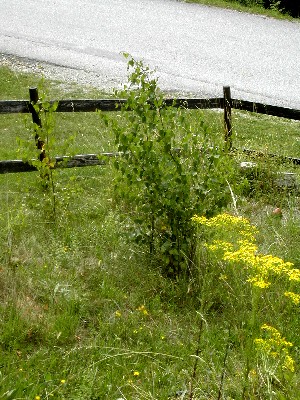
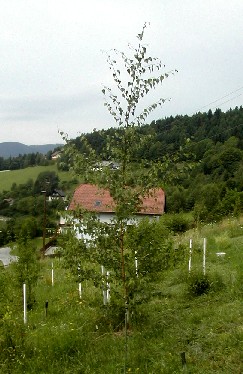 But...
wherever I looked, there were young birch seedlings growing. They tenderly
touched my heart as if saying "we understand your sacrifice, here is some
solace." One of the birches (I had seen it already for two years but didn't know
about the others) is already bigger than a man. Another tree, a cornel cherry
which had been destroyed by Paul's very first mowing orgies, was making a second
attempt, coming back from its roots! Paul and I marked all the newcomers with
white sticks to protect them against a tired gardener's scythe - in a few years
they will be markers themselves.
But...
wherever I looked, there were young birch seedlings growing. They tenderly
touched my heart as if saying "we understand your sacrifice, here is some
solace." One of the birches (I had seen it already for two years but didn't know
about the others) is already bigger than a man. Another tree, a cornel cherry
which had been destroyed by Paul's very first mowing orgies, was making a second
attempt, coming back from its roots! Paul and I marked all the newcomers with
white sticks to protect them against a tired gardener's scythe - in a few years
they will be markers themselves.
I even found two spaces to plant one year old gingko trees which I had grown from seeds (before I learned that they now found their way into the garden shops)!
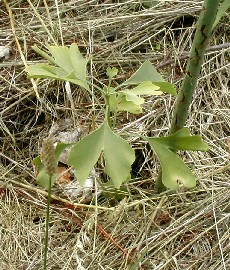 They
were perfect circles without any other seedling, as if somebody had marked them
off. I probably don't need to explain the unique memory-enhancing features of
gingko - but did you know that they are the only surviving variety of the oldest
existing form of trees, and that despite coming from a warm climate, they are
some of the hardest trees we know?
They
were perfect circles without any other seedling, as if somebody had marked them
off. I probably don't need to explain the unique memory-enhancing features of
gingko - but did you know that they are the only surviving variety of the oldest
existing form of trees, and that despite coming from a warm climate, they are
some of the hardest trees we know?
Farther down into the former flower garden I re-encountered the two sitting rocks we had planted instead of a bench. They were overgrown by a very lively ant hill. I asked the crawlers a few times to relocate, but they wouldn't listen, so Paul went out and conviced them with a little fire (we very rarely do these things, but in this case I simply wanted to keep my sitting place).
 A
few meters deeper into the sleeping patch, I found that while the red and black
currants had more or less disappeared, for the first time I had really great
growth on the blueberries!
A
few meters deeper into the sleeping patch, I found that while the red and black
currants had more or less disappeared, for the first time I had really great
growth on the blueberries!
 They
had greatly suffered from the dry and hot weather in the last years and I
thought I had lost them.
They
had greatly suffered from the dry and hot weather in the last years and I
thought I had lost them.
First I found only five of the six, but when I mowed around the few remaining treasures, I found the sixth plant as well and it is making a good recovery. Even the mooseberries and bilberries which grow at their feet are still there. They don't have fruits, but the plants are alive and happy.
My intention to supply them all with fresh peat twice a year (they need a slightly acidic soil) had not worked out, but somehow they negotiated survival conditions with the surrounding ecology entirely on their own!
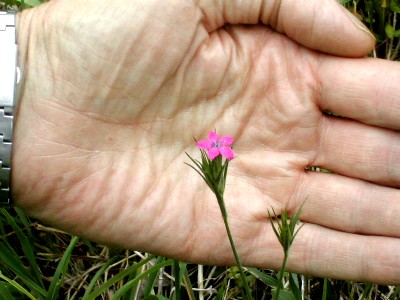
 On
the way back up to the house I made a foto of two other treasures. One is a tiny
flower (I would have to look up its name), the other one the hand of my lover
Paul...
On
the way back up to the house I made a foto of two other treasures. One is a tiny
flower (I would have to look up its name), the other one the hand of my lover
Paul...
I went through the field with spring lettuce plants that are already going into seeds. So far, I never found the time to harvest seeds from my vegetables. If I can make it this year, I have gone full circle as a gardener for the first time. From there on, I might even be able to experiment with creating new varieties.
I have to go back to programming now, but I really enjoyed meeting all the "people" in my garden and telling their stories. Maybe you enjoyed it too!